Tuesday, August 16, 2011

Out Damned Spot...Out I Say!


Anyone who's been through a halfway decent English class (and I can definitely say that Mrs. White's English class at Richland was so much more than decent) you have heard that particular line. If you are a senior in high school, it's so cool to say the line as Lady Macbeth slides deeper into insanity. Yes, it's cool then because you get to say a cuss word in class and nobody will get onto you for it. But as time passes, you have to wonder if any of the famous Shakespeare play is true.

The answer to that is sort of...

According to Shakespeare, Macbeth was a young Scottish noble who protected the country from an invasion by troops from Norway and Ireland. As a reward, the elderly king Duncan gives the hero a title. Witches tell Macbeth that he will become king at Duncan's death, so strong a ruler that he would only be defeated by a man not of woman born. They also tell Macbeth's friend Banquo that he (Banquo) will father a long line of kings. When Duncan visits Macbeth's castle, Lady Macbeth can't wait for the elderly king to die and make the prophecy come true so she goads her husband into killing the king so he can take the throne. Banquo doesn't quite believe the husband and wife tale that the guards did it so he definitely doesn't trust new King Macbeth. Macbeth doesn't trust Banquo either because of the prophecy and sets out to kill Banquo and his son, Fleance. He halfway accomplishes this because Fleance gets away. Lady Macbeth loses it because she thinks Duncan's blood is on her hands and she dies, most likely by suicide. The Scottish nobles turn against Macbeth and he is ultimately defeated by the young Macduff. How did Macduff win? Well, he wasn't actually "born;" he was delivered by Caesarean section.

Historically, Duncan was a very young man when he was king. So young in fact that he turned to older, more experienced men to help him rule his kingdom. One of these men was a seasoned soldier named Macbeth. Essentially, Macbeth (who already had a title, BTW) was the power behind the throne. Despite this power, Macbeth couldn't keep Duncan from entering into several ill-planned battles, including one in Macbeth's own territory in Scotland. But Macbeth still stood behind Duncan, advising him to the bitter end. Ultimately, Duncan's penchant for bad battles gets him killed in August 1040. This had nothing to do with Gruoch, Lady Macbeth, so she didn't have to wash out any damned spots. Duncan's queen and 2 young sons are forced to flee Scotland when Macbeth is named the new king. Macbeth actually rules for 17 years but it's not an easy rule. He was faced by infighting amongst his own nobles (if you know anything about Scottish history, this shouldn't come as a surprise) and invasions from England and Ireland. 17 years and 2 days after taking the throne, Macbeth loses it when Duncan's son Malcolm invades Scotland and retakes the title for himself, killing Macbeth in battle.

Where does Banquo fit into all of this? According to Scottish history, the witches' prophecy came true because King James VI (the one famous for the King James Version of the Bible) claimed that he was descended from Banquo. Lesson learned- never doubt Shakespeare's witches.

Did Lady Gruoch Macbeth commit suicide like Shakespeare insinuated? Nobody knows because she simply disappears from history once Malcolm took the throne. But you have to admit, the story is cool and even though it's been over 20 years since I was in an English class, it's still fun to wring my hands and say the line, "Out damned spot...out I say!"

Monday, August 15, 2011

Is the third time really the charm?


I've been hearing this phrase a lot lately..."Well just remember, the third time is the charm." I guess if I was British, people would be saying "Three times lucky." But this got me thinking, why is the third time of trying to do something supposed to be that magical time when the Heavens open and rays of light rain down on you as you have one of those epiphany moments when everything just comes together the way you want?

Is the number "3" considered lucky? Well, that depends on where you are. In China, that's a big fat yes. Three is a lucky number. It's a prime number; the Chinese pronounciation of "three" sounds like the pronounciation of the word "life" and since living is lucky, three is lucky; nine is evenly divided into three parts by three; in laying out your home, putting things in threes or in a triangle is very fung shui.

But this saying didn't come from China; it's a British/American saying. In World War I, doing something three times wasn't considered lucky because it might give German snipers time to see you, target you and shoot you. Plus, there was also the belief that deaths came in threes.

The saying itself comes even further back from that though. In the late 1800's, West Country sailor John Babbacombe Lee was arrested and convicted of murdering Emma Keyse. He was sentenced to death by hanging. The first time, the rope broke. The second time, the scaffold broke. The third time, I'm not sure how he did it, but bad boy John didn't die. According to English Common Law, the sentence had been carried out so a judge commuted it to life in prison. He did get out years later on parole for good behavior and lived until 1940.

I'm not really sure if I can say that the third time truly is the charm but if I'm ever sentenced to hanging, I certainly hope that the folks acting out my sentence are as good as the ones in charge of John Lee's.

How about you? Have you ever had anything in your life where you could say the third time was the charm? Tell us in the comments.

Wednesday, August 3, 2011

An August Month


My mom has always said that as you get older, the months of the year fly by faster and faster. When I was young, I rolled my eyes at this but now that I have a little age on me, I have come to realize that she is right (Mama, if you read this, yes, I said you were right about something- relish it, it might not happen again!)

Since the months do seem to fly by, it's easy not to take the time and wonder why July and August don't quite fit in with all the other months. January is named after Janus, the two-faced Roman god of choices, since January's weather can be notoriously two-faced. February comes from Februa, an annual purification ritual held during the month. March through June are named after other Roman gods and goddesses. September through December come from the Latin words for seven, eight, nine and ten respectively because back in the day, the original Roman calendar had ten months.

But July and August are different. They are named after real people- the great Julius Caesar and his nephew Octavian (who is in the pic above). Octavian might not ring a bell to you if you aren't really interested in ancient history but following the assassination of Uncle Julius, young Octavian took the bull by the horns and set out to move himself up from one of three leaders of the Roman Republic to the first leader of the Roman Empire. It wasn't easy- years of fighting big names like Marc Antony and Cleopatra- but ultimately he achieved it. Emperor Octavian just didn't have the right ring to it, so he adopted the new moniker, Augustus, which means "the revered one." Under Augustus, the Roman Empire became the strongest, most dominant entity in history (IMHP).

To honor Uncle Julius, who despite modern popular belief was well-beloved by the people of Rome, Augustus decreed that Quintilis, the month of Julius' birth would forever be renamed July in his honor.

Many years later, the Roman Senate decided that since Augustus was so revered by the people that he was seen as a god amongst men, he also needed a month named in his honor. Popular belief says that Augustus himself chose the month of Sextilis because it fell after July and that he ordered days removed from February to make Sextilis have the same number of days as July (Unc can't have more days than Augie!). However, this is not true. The month of Sextilis has always had 31 days just like July. Sextilis was chosen simply because many of Augustus' greatest victories, especially the fall of Alexandria, Egypt, came in that month. To honor the man and all his accomplishments, Sextilis became August.

So as you spend the next few days battling 100+ degree weather, stay cool by finding an air conditioned spot in your local bookstore and learn a little more about why Julius and Augustus Caesar are such interesting men in history. They are definitely 2 of my faves!

Monday, August 1, 2011

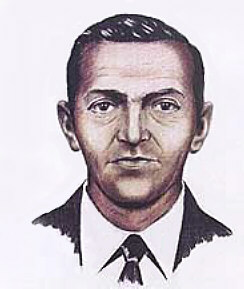
Who is D.B. Cooper?


Conspiracy theorist that I am, it's surprising that I had never heard of the infamous D.B. Cooper until a few years ago when he was a character in Prison Break. The guy playing him (who also played Gibbs' mentor on NCIS btw) piqued my interest enough that I did a little Wiki research back then.

In November 1971, a fairly average looking white guy in a suit and tie boarded a Boeing 727 in Portland, OR, carrying a black briefcase. After take-off, he waved a flight attendant over and handed her a note telling her that the briefcase contained a bomb and he was hijacking the plane. The plane was to land in Seattle, WA, for refueling where he wanted $200,000 in unmarked bills and several parachutes waiting for him. Otherwise, he'd blow up the plane.

The FBI complied with his wishes and Cooper released the planes passengers but took off in the newly refuled plane with the flight crew. Over the Oregon-California border, the plane experienced a pressure loss and was forced to make a quick landing. The plane was searched by the FBI but Cooper, 2 of the parachutes and the bag o' cash were gone. Most likely, the pressure loss occurred because of Cooper opening the door and jumping. I'm assuming that since none of the crew noticed the open door, it shut on its own after he jumped. Either that or they were hitting the little liquor bottles.

Although the FBI thought that Cooper probably got killed during the jump, they did launch a manhunt. The "unmarked" bills weren't quite so unmarked. They all had "L" designations which would allow them to be tracked. Despite all the tips, leads and sightings received over the years, no trace of Cooper or the money has ever turned up. All of the folks (including a woman who had undergone gender reassignment surgery a few years before) suspected to be Cooper were exonerated.

To this day, the D.B. Cooper case is considered to be the only unsolved hijacking in American aviation history and is one of those cases that just keeps investigators scratching their heads, even 40 years after the fact.

Yesterday, the FBI announced that it was reopening the case because new evidence has been discovered, pointing to a completely new suspect. Maybe after all these years, the mystery will be solved.

All I have to say about this is that if the guy from Prison Break really was D.B. Cooper, I'm jealous because he got to spend a lot of quality time with Wentworth Miller ;)

Saturday, July 16, 2011

A Ban on Kissing? Say it ain't so!


Well, actually it was in England beginning on July 16, 1439, and there was a good reason for it.

In 1439, Europe saw the first cases of a disease that stunned the world. You might feel completely fine now and be dead 24 hours later. High fevers wracked the afflicted, hacking coughs, even huge blackened boils in the armpit or groin. Soon, so many people in Europe were sick that this disease was referred to as the Great Pestilence. Today, we remember it as the Black Death.

Medical care at the time was laughable; the germ theory hadn't been proposed yet. People didn't understand the concept that the organisms causing this horrific disease actually lived in the rats that were all over the place. Fleas would first bite the rats and then bite humans, transferring the plague germs over. Humanity was facing the beginning of a pandemic of unimaginable proportions and all they could do was wait and pray.

When the first plague cases broke out in England in July 1439, King Henry VI decided to be proactive. In a decree sweeping the country, he banned all kissing until plague season had passed. His reasoning? If your lips were kept chaste, the "small specks" of plague would not spread.

Did it work? Not really. About 30% of England's population died of the Black Death that year despite Henry's anti-kissing stance. But I guess it's safe to say the cases of mono dropped dramatically!

Tuesday, July 5, 2011

Sample Movie Review- Redux


Poor little summer students! A whole semester's worth of work crammed into a single month. Your brains and hands will be completely bumfuzzled by the end of the summer. Especially those of you taking more than one class!

Since we are running on such a compact schedule, I dug up an old movie review to give you guys an example of how to do the project. This is definitely an A paper! If you are wondering how to format your own review, take the time to read this one. I didn't include the works cited page but remember that you need one. (Just don't feel tempted to steal any of the ideas. That's plagiarism and you know how I feel about that).

Good reading, and as always ask if you have any questions.


Your Name
Ramona Shelton
American History II
August 2, 2010

The 2001 blockbuster, Black Hawk Down, directed by Ridley Scott and produced by Jerry Bruckheimer was based directly on Mark Bowden’s New York Times best seller by the same title. Unlike many of Hollywood’s big budget films, this project was unbelievably historically accurate. The facts, events, and statistics in the movie were very accurate but there were some differences as well.

When mentioning the military units involved in the conflict, the movie failed to mention the involvement of U. S. Navy’s SEALs. “ The Humvees were filled with Rangers, Delta operators, and four members of SEAL Team Six, part of the navy’s special forces branch” (Bowden 5). These soldiers are known to be world class warriors. Their involvement would be influential due to their unparalleled military training. Besides, every other military faction, from Delta special forces, army Taskforce Rangers, and the pilots of SOAR (Special Operations Aviation Regiment), was mentioned in the movie (Bowden 5).

Sometimes the producers may have made changes about the facts of a story in order or add specific details in order to make the story easier to follow. There were more than 140 soldiers involved in these rescue missions. It would have been impossible to be able to keep up with them all. So the producers decided to write the Task Force Ranger’s names on their helmets so that the audience can keep up with some the characters involved in the main story line. Also unlike in the book, not all of the characters are referred to by name. It would be way too overwhelming for the audience to try to keep up with all the names of all of the characters in the story. Bowden gave the names and ranks of the soldiers as they appear in the novel. The characters in the movie tend to blend together in the “fog” of war since they were almost all wearing the same exact dirt-covered uniforms. This allowed you to immerse yourself into the movie without worrying about trying to differentiate between all the soldiers.

In the movie, Sgt Eversman remained in the city over night stranded with his fellow Rangers fighting in the night siege. He actually returned to base later in the day with the Col. Danny McNight’s convoy. “Another minor factual error included the role and position of Sgt. Eversman, the main character of the movie, who in reality returns to base with his convoy during the day with the prisoners” (Walker. Jr). I feel it was easier for the audience to stay involved in this part of the movie because they have come to know and like Josh Hartnet’s character, Sgt. Eversman. If Hartnet’s character had returned to the base as he did in real life, the audience may not have kept the connection with the soldiers remaining in the city overnight.

Ewan McGregor’s character of Specialist John ”Grimsey” Grimes, a U. S. Army Ranger, is based on a soldier named SPC John Stebbins. This character’s name was changed due to the fact that he was found guilty by court marshal of sexually assaulting his daughter in 1999 (US v Stebbins).

In the film, the soldiers were unsuccessful in the attempt to free Chief Warrant Officer Clifton “Elvis Wolcott’s body and his copilot’s body from the cockpit of the downed Super Six-One. With time quickly running out we were led to believe that they may have had take drastic measures in order to free his lifeless body because of their motto, ‘No man left behind.’ “Several Rangers pulled at the crumpled wreckage to free Wolcott and the copilot. To no avail: it would eventually take a humvee with a towrope to pry the bodies free” (Van Voorst).

Despite a few simple inaccuracies in the movie, the movie as a whole was very historically accurate. It was so important for the movie to appear as accurate as possible that forty of the actors received two weeks of Ranger training. Three of those received two additional weeks of specialized commando training in order to portray the Delta Force operators. The actual Ranger company involved in the operation in 1993 not only played the extras in the film, but also performed the fast roping stunts in the movie. Like the actors portraying the Rangers, the actors playing the helicopter pilots received specialized training as well. Other than Wolcott and Durant, some of the pilots from the original 1993 operation played themselves in the movie. In addition, the U. S. Army provided all the helicopters, humvees, and weapons used in the filming of this movie (historychannel.com).

Finally, the lack of ethnic diversity of the casting proved the genuineness to the actual soldiers represented in the original operation. “Only one of the forty American soldiers depicted is black. (Special Forces tend to be much whiter than the rest of the Army)” (Sailer)

Ridley Scott’s attempt to create a movie that accurately depicts the Battle of Mogadishu was a total success. It was not meant to glorify war but simply show what our soldiers experience when confronted with battle. This movie was shot from an American perspective. It may be a little biased but, that is to be expected from a film shot about such a recent event. The movie was released only eight short years after the actual event. Hooah!

Saturday, June 11, 2011

Diamonds ARE a girl's best friend...but why do we put them in engagement rings?


Ahh, June... the month most typically associated with weddings. Last year, because my baby brother got hitched, I did a series of posts on wedding traditions. This year, slacker that I am, I didn't even remember the fact that they had reached their first anniversary (love you guys, congrats! sorry I'm such a bad sister!)

Personally, as far as weddings go this year, the only one that caught my eye was the royal wedding. Loved it! Loved it!! LOVED IT!!! It took me back to 1981 when I was a wee little tyke watching Diana go down the aisle in that absolutely gorgeous (yet completely impractical) fairy tale dress. For the first time, I realized that princesses were real. One thing that has always stuck with me about that wedding- and now with the next generation's- was the fact that Diana's engagement ring had a sapphire in it. Heaven forbid (imagine me fanning myself here in a ladylike Southern belle kind of way)... aren't wedding rings supposed to have diamonds in them!?!

Not necessarily. And to be honest with you, the idea of the engagement ring is a fairly modern one. Traditionally, when the bridegroom-to-be or his family negotiated the engagement or betrothal with the bride-to-be's family, there was an exchange of gifts. Girls had some sort of dowry, a bride price if you will, that showed the value of the bride. Depending on how wealthy or important the families were, the dowry might include goods, animals, gold or lands and property. Wonder how many goats I would be worth?

Notice that this was very impersonal. For the most part, betrothals were. The couple was put together for the betterment of both families, not for love. However, over time, it became common for the prospective bridegroom to give his future wife some sort of token of affection (again, I would probably would have gotten a goat, ugh!) Men of wealthy means would give gifts of jewelry. With rings symbolizing eternity, no beginning, no end, voila! The engagement ring was a no brainer. It marked your future bride as yours and the more elaborate it was, the bigger of a catch you looked like as a husband.

Engagement rings tended to be simple bands of gold, maybe some sort of design hammered into them. But in 1477, Archduke Maximilian of Austria stepped up the engagement ring game. Maximilian presented Princess Mary of Burgundy, his future bride, with an engagement ring with a huge diamond flashing right in the middle of it. Oh yeah, Max was the man! Whether he realized it or not, this action started a trend. From that point forward, for those with means, an engagement/betrothal ring had to be bigger and better, with the diamond becoming the traditional stone. Diana's ring and others notwithstanding, diamond engagement rings constitute 80% of the engagement rings given today.

I think that given the chance, I'd pull a Diana when it came to engagement rings. I don't want a typical diamond solitare. Give me an emerald surrounded by smaller diamonds. And guys, let me speak for all the ladies here, when it comes to engagement rings, size does matter :)